
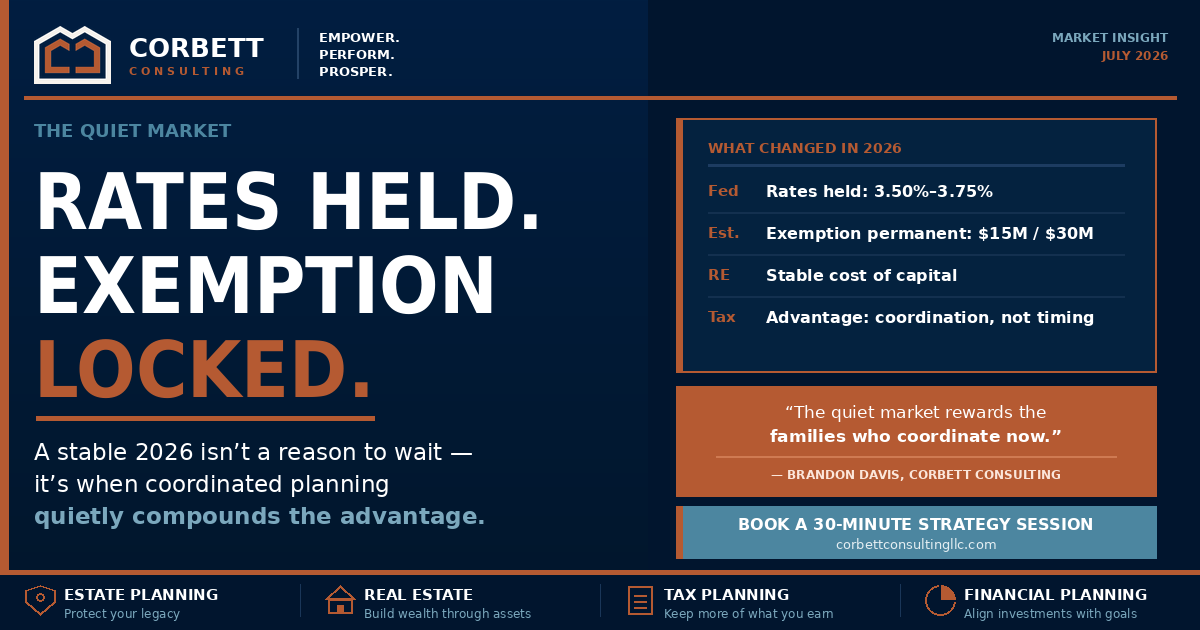

Rates Held, Exemption Locked: Why the Quiet Market of 2026 Is a Coordination Moment for Your Clients

Cory Wonner
There was no dramatic headline out of the Federal Reserve this week. On July 29, the Fed held its benchmark rate steady in the 3.50%–3.75% range — the fifth consecutive meeting with no change, in one of the most divided votes in years, with three officials pushing for a hike. Combine that with an estate tax exemption that is now permanently set at $15 million per person, and 2026 is shaping up to be a year defined not by upheaval, but by stability.
For advisors, that stability is easy to read as "nothing to do." That would be a mistake. A quiet policy environment is precisely when coordinated planning separates the families who compound from the families who drift.
Why "Boring" Is the Opportunity
When rates are whipsawing and tax law is about to sunset, everyone pays attention. Urgency does the selling. The harder — and more valuable — moment is the one we're in now: rates holding, the exemption locked, no cliff on the calendar. The pressure is off, which is exactly why most families will do nothing.
Here's the problem with doing nothing. The absence of a deadline doesn't mean the absence of opportunity. It means the opportunity is quieter, and it accrues to whoever is actually coordinating a strategy rather than waiting for the next crisis to force a decision.
What the Rate Hold Actually Means for Your Clients
A steady rate environment has second-order effects that only show up when someone is looking at the whole picture:
Borrowing costs are stable but elevated, which makes the structure of leverage matter more than the timing of it. Clients who treat debt opportunistically — waiting for a cut that the Fed's own divided committee can't promise — are standing still. Clients who deploy leverage strategically, coordinated with their tax and cash-flow position, keep moving regardless of what the Fed does in September.
Stable rates also mean cash-flowing assets can be underwritten with more confidence. When the cost of capital isn't moving unpredictably, the math on an income-producing property is cleaner. That's an advantage — but only for clients whose real estate decisions are coordinated with their tax and financial plans, not made in a silo.
What the Permanent Exemption Actually Means
The estate tax story of 2026 is the one most likely to be misread. For years, planning ran against a sunset: the exemption was scheduled to drop by roughly half at the end of 2025, and the entire strategy was "use it before you lose it." The One Big Beautiful Bill Act eliminated that cliff and set the exemption permanently at $15 million per individual, $30 million per married couple, indexed for inflation starting in 2027.
The reflexive read is relief: the deadline is gone, so the pressure is off. But permanence changes the strategy rather than ending it. Families no longer have to use the full exemption all at once to beat a clock — which means the sequencing of gifts, the interaction with real estate and business assets, and the coordination with state-level estate taxes (which haven't moved and can still be significant) now matter more, not less.
And this is where the silos do real damage. The exemption lives in the estate attorney's lane. The real estate lives in the Realtor's and lender's lanes. The tax mechanics live with the CPA. The permanent exemption is only an advantage when someone is coordinating all of them — because the value now comes from thoughtful sequencing over years, not a single deadline-driven transaction.
The Coordination Moment
Put the two together and 2026 comes into focus. Rates are stable, so the advantage goes to structured, coordinated leverage rather than timing bets. The exemption is permanent, so the advantage goes to thoughtful multi-year sequencing rather than deadline-driven scrambles. In both cases, the edge belongs to the families whose advisors are coordinated — and evaporates for the families whose advisors are simply waiting for the next headline.
That's the paradox of a quiet market: it rewards exactly the kind of patient, coordinated, whole-picture planning that's hardest to sell when nothing feels urgent. Which means the advisor who can help a client see the opportunity in the quiet is the one who earns the relationship.
Where Corbett Fits
This is the function of the Building Wealth Hub: coordinating real estate, tax, financial, and estate planning into a single strategy, held together by one accountable partner. Not to replace the CPA, the attorney, the lender, or the planner — but to make sure that in a year without a forcing deadline, someone is still making sure the whole strategy moves forward.
If you have clients who are reading the calm of 2026 as a reason to wait, that's the conversation worth having. The families who coordinate now — while it's quiet — are the ones who'll have compounded by the time the next headline arrives.
Brandon Davis is the Founder and Principal of Corbett Consulting LLC, a boutique wealth coordination firm based in Salem, Ohio. He has guided business owners, investors, and high-net-worth families for 25+ years.
330.565.9013 · bdavis@corbettconsult.com · corbettconsultingllc.com
Book a 30-minute strategy session: corbettconsultingllc.com